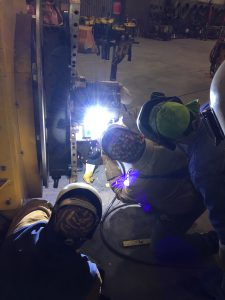

Welder Occupation
This occupational analysis identifies task performed by qualified welders across Canada. A welder is a tradesperson who uses a wide variety of occupational knowledge, skills and abilities in combination with cutting, gouging and welding processes to tack and weld assemblies and fabrications within a quality control system.
The welder must be able to work on new construction or perform repairs. All work must be recorded accurately. This is due to the fact that the work of the welder is frequently in areas of construction where faults or defects could be hazardous to life and costly. This critical aspect of the welder’s work can be, in part, attributed to the variety of equipment types and designs available from a wide range of manufacturers.
The welder’s work is usually, but not exclusively, found in industrial and commercial sectors such as assembly plants, factories, shipbuilding, refineries and building construction. Welders may work on the same site for prolonged periods and may routinely perform a variety of tasks including vehicle and implement repairs or construction, oilfield fabrication and repairs and heavy equipment servicing and maintenance. They may also specialize in areas such as underwater welding and welding of non-metal materials.
Welders often perform their jobs in conditions that present physical discomfort and danger such as hazardous fumes, working at heights, in hot, cold, humid weather conditions and in cramped, dark areas. To perform their work the welders rely on their knowledge of metallurgy and the effectiveness of the equipment being used; their knowledge of codes, regulations and laws; their experience in a wide variety of work situations and requirements; their ability to operate hand and power tools; and, their ability to determine the most appropriate means of proceeding with the work.
Welders must also rely on some important attributes: their mechanical and mathematical aptitudes, above-average physical condition, eye-hand coordination and their ability to plan and think sequentially as well as three-dimensionally.